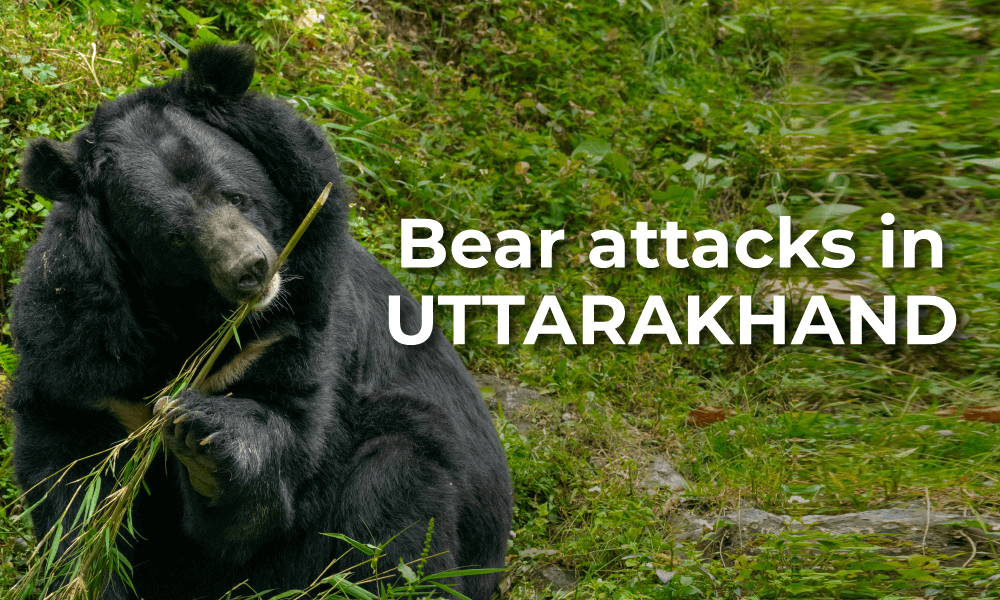
Bear attacks in Uttarakhand, but bear is found in all parts of India, from north to south, from east to west.
India has four species of bears:
- The sloth bear, the most common type of bear, is found everywhere in India, except the snowy mountains of India.
- The Himalayan black bear is found in Uttarakhand, Himachal Pradesh, Jammu & Kashmir, Sikkim, northern West Bengal and the Northeast.
- The Himalayan brown bear lives at very high altitudes.
- The sun bear is found in parts of Northeast India.
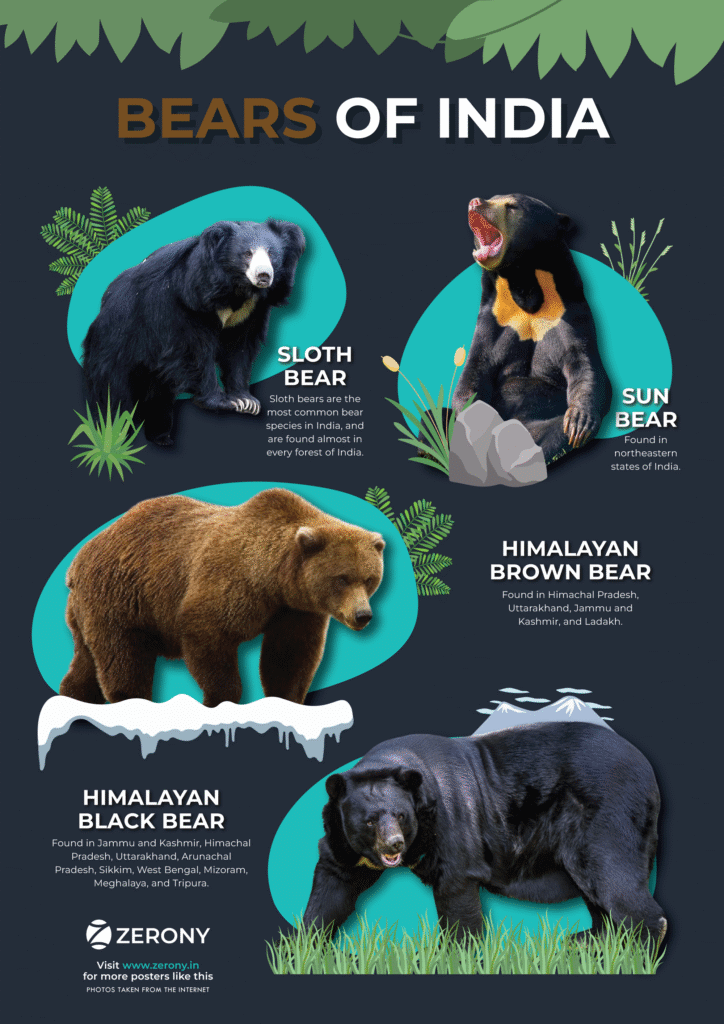
And Uttarakhand is home to 3 types of bear: the sloth bear, the Himalayan brown bear, and the Himalayan black bear.
Today, we are going to talk about the Himalayan black bear, which is responsible for almost all the attacks in Uttarakhand. In Uttarakhand, Himachal, and Jammu Kashmir, the Himalayan black bear or “kala bhalu” lives in the elevation from 1,000 meters up to the tree line (around 3,000 meters).
What does a black bear eat?
Black bears are included in the list of carnivorous animals, but they eat very little meat; their diet mainly consists of fruits, berries, seeds, grasses, bamboo, herbs, and plant matter.
Black bears rely heavily on Banj Oak (Quercus oblongata), Tilonj/Moru Oak (Quercus floribunda), Kharsu Oak (Quercus semecarpifolia), Indian Horse Chestnut (Aesculus indica), and Hazelnut (Corylus jacquemontii). These can be considered as black bears’ favourite all-time food.
Yearly cycle of the black bear
Winter (December–February): They enter hibernation, sheltering in caves, rock crevices, or tree hollows. Metabolism slows, and they survive on stored fat.
Bear hibernation is a deep, winter-long state, where bears lower their metabolism, heart rate, and body temperature to conserve energy, usually for 3–4 months. During this time, they do not eat, drink, or urinate, relying instead on stored fat for survival.
Spring (March–May): They emerge from hibernation, during this time, they are hungry and weak, having lived off stored body fat for weeks or months. Their diet mainly includes fresh grasses, young leaves, roots, and other soft vegetation.
Summer (June–August): In summer, bears are highly active and spread across forested areas. Food is more abundant, including fruits, berries, insects, honey, and vegetation.
Autumn (September–November): The most important feeding season for Himalayan black bears. They enter a phase called hyperphagia, where they eat almost continuously to build fat reserves for winter. Their diet shifts toward high-energy foods such as nuts, acorns, seeds, fruits, and sometimes meat.
Why are so many bear attacks in Uttarakhand?
Normally, bears hibernate for three to four months in caves, but this requires three conditions: extreme cold, heavy snowfall, and a lack of food in the forest.
When snowfall is reduced, temperatures are warmer, and food is easily available in villages or garbage dumps, bears no longer need to hibernate and remain active throughout the year.
Habitat and forest loss, and uncontrolled tourism in the Himalayas have led to massive amounts of garbage, attracting bears to human settlements.